The Symbiotic Flow Weaver
From tile by tile to plasma symbiosis. An active thermal shield that works with the reentry plasma instead of merely surviving it — weaving the fire around the hull, harvesting its power, and landing ready to fly again.
- ~18,000
- ceramic tiles replaced by an active system
- Near-zero
- refurbishment between flights, by design
- 2025–26
- technologies it builds on — feasible now
The idea in one minute
Today, a reusable spacecraft still comes home behind a shield of thousands of hand-placed ceramic tiles — proven, but slow to inspect and heavy to carry. The Symbiotic Flow Weaver replaces that passive armor with an active one: superconducting magnets and lightly seeded plasma weave the searing reentry flow around the hull, harvest power from it, and open a window through the comms blackout. The ship lands ready to fly again — no tile crew required.
- 0:00
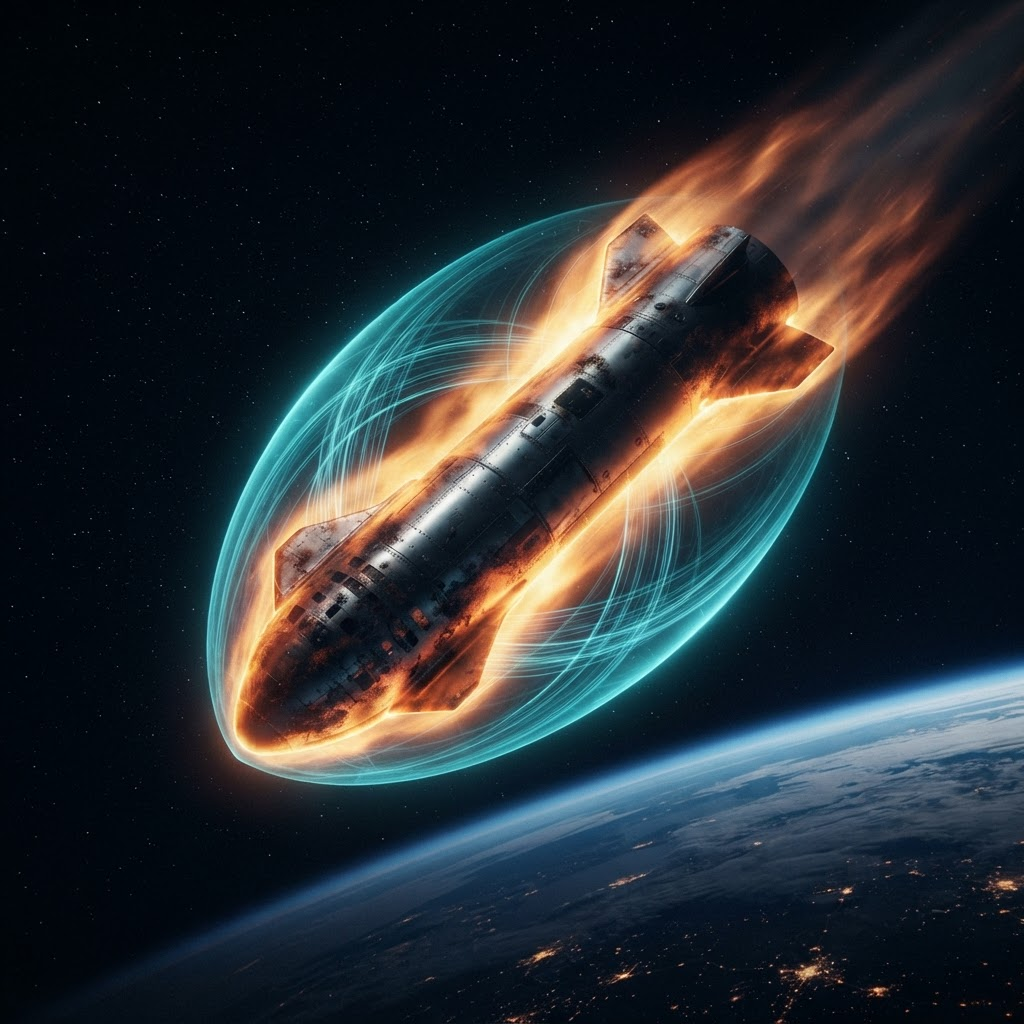
Starship falls toward Earth. Its belly glows — thousands of tiles doing a 1960s job.
- 0:15
Cut to the same descent, reimagined. A cyan field blooms ahead of the hull.
- 0:30
Plasma bends around the ship in woven streamlines — deflected, not endured.
- 0:45
The ship lands, cool and clean. No tile crew. It refuels and flies again.
1960s echoes in 2026
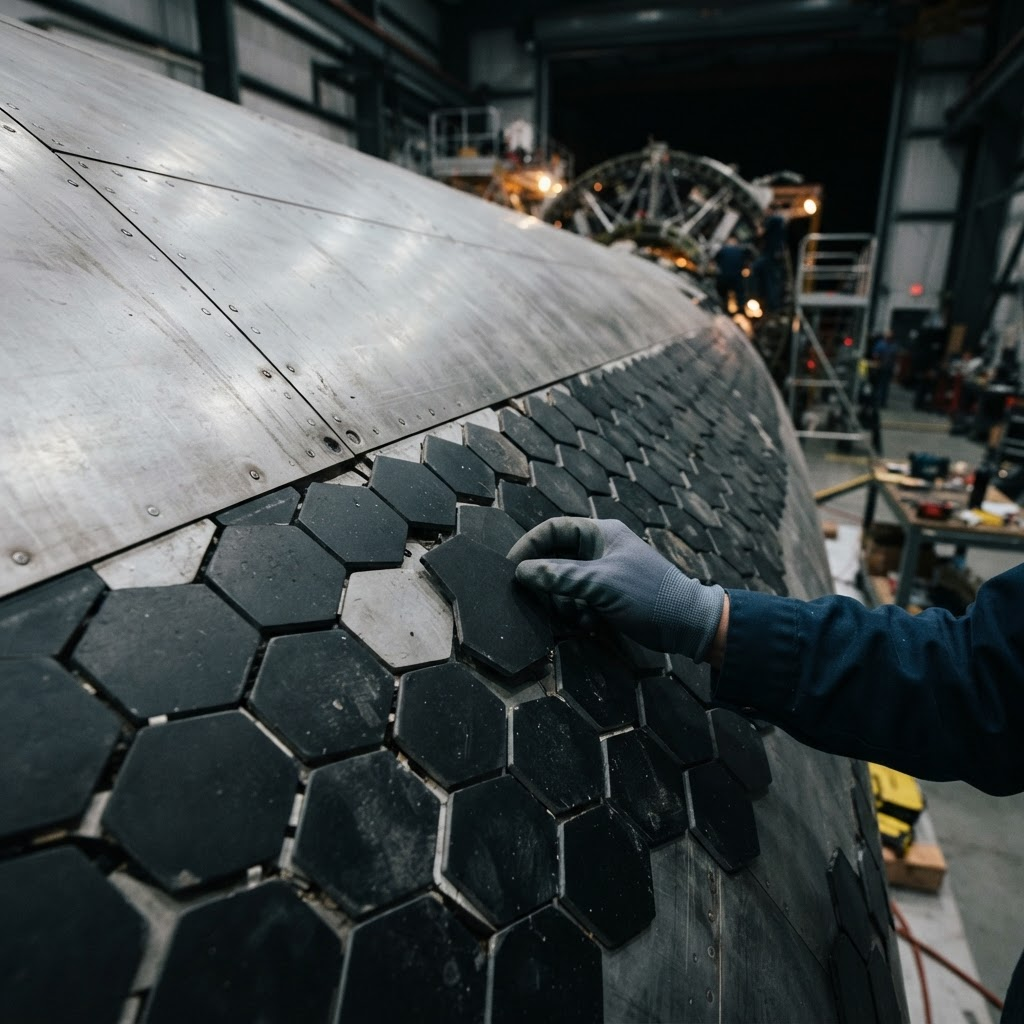
Ceramic ablative and reusable tiles are a genuine engineering triumph — they work, and they have carried humans home for decades. But the underlying idea is over half a century old, and it is showing its age next to the elegance of a modern, deeply reusable vehicle.
Thousands of hand-placed parts
A tiled belly can carry on the order of ~18,000 individually bonded ceramic pieces. Each one is placed, gapped, and inspected largely by hand.
Inspection-heavy turnaround
Every flight ends in a painstaking survey for cracked, missing, or debonded tiles — a process that fights directly against rapid reuse.
A permanent mass penalty
The shield is dead weight you carry up and back every mission, whether or not it was stressed — mass that could have been payload to Mars.
A ceiling on cadence
Manual refurbishment sets the real limit on how often a vehicle can fly. Airline-scale reuse cannot be reached one tile at a time.
Raptor 3 shed its plumbing into a single, clean, printed whole. The heat shield never got that memo. If the engine can evolve, so can the skin that keeps the whole ship alive on the way home.
A shield that works with the plasma
The Symbiotic Flow Weaver stops treating reentry plasma as an enemy to be survived and starts treating it as a programmable medium to be orchestrated. Nine subsystems — each an extension of technology maturing today — combine into one adaptive, self-powering, self-healing thermal protection system.

Programmable metamaterial skin
A structurally integrated outer panel engineered at the sub-wavelength scale — photonic and electromagnetic bandgap structures whose emissivity and field response are tuned on demand. It radiates and reroutes heat far better than bulk ceramic and forms the load-bearing canvas the rest of the system weaves through.
HTS magnetic array
High-temperature superconducting coils generate an inducted magnetic field that stands the plasma off the hull, forming an artificial magnetopause — the same physics that protects planets, shrunk to vehicle scale.
Plasma weave layers
The field organizes the ionized boundary layer into standing plasma waves and braided magnetic flux tubes — a dynamic Faraday cage and radiator that holds cooler, radiating plasma layers away from the hull, so heat is deflected rather than absorbed.
Catalytic localized seeding
Embedded catalytic nanoparticles and laser-induced micro-discharges seed the boundary layer with trace easily-ionized species exactly where and when needed. Conductivity is boosted locally — recyclable via onboard chemistry — without the mass penalty of global seeding.
MHD harvesting & self-powering loop
The same magnetohydrodynamic interaction that deflects plasma extracts electrical power from it. That power feeds the system itself — recharging batteries and driving the lasers and electromagnets — with the goal of a net-positive loop and surplus for payload or auxiliary systems.
AI real-time orchestration
An onboard model with quantum-inspired optimization reads thousands of sensor channels and continuously tunes field strength, seeding, and harvesting thousands of times per second — shaping the standing plasma waves that hold the shield in its optimal state.
In-plasma micro-transpiration
At peak heating, micro-injections of methane or harvested water vapor at the weave points dissipate energy inside the plasma layers themselves — an ablative-like cooling that spends consumables in the flow, not on the hull.
Phase-change thermal cores
As the weave collapses on descent, residual heat is parked in phase-change cores within the panels and dumped after landing — smoothing the thermal load and keeping the skin ready for inspection, not reconstruction.
Self-healing damage adaptation
If a panel takes a micrometeorite strike or plasma erosion, the controller reroutes fields and flow to neighboring zones and flags that single module for a minimal ground swap — turning a potential cascade into a routine part change.
How it works, phase by phase
Entry interface
In the thin upper atmosphere the HTS array spins up and the artificial magnetopause forms meters ahead of the hull. Laser and microwave pulses pre-excite the incoming air for better magnetic coupling, pushing the initial shock layer outward before peak heating begins.
Peak heating
Catalytic seeding boosts conductivity and the plasma-weave channels engage. Micro-transpiration injects methane or harvested water vapor into the weave points for in-plasma cooling, while the AI holds standoff stable and MHD harvesting powers the loop.
Comms & control
By shaping the plasma sheath, the system opens managed windows through the traditional reentry blackout and provides virtual aerodynamic control moments without moving parts — shallower glide paths, lower g-forces, precise targeting.
Terminal descent
As dynamic pressure falls, the weave collapses into film cooling and radiative metamaterial emission, and residual heat is parked in phase-change cores for post-landing dump. The vehicle lands with a skin that needs inspection, not reconstruction — ready to fly again.
Key advantages
- Major mass-savings potential versus a full tile shield
- Near-zero refurbishment for genuinely rapid reuse
- Better performance at Mars entry velocities and thin atmospheres
- Managed comms windows through reentry blackout
- Virtual aerodynamic control with no moving surfaces
- Onboard power from the plasma the ship must fly through anyway
- Self-healing flow rerouting around damaged panels
- Surplus harvested power for payload or auxiliary systems
Honest numbers, real constraints
Ambition is not a substitute for a mass, power, thermal, and reliability budget that closes. SFW is designed to earn its place on a vehicle that already lives or dies by iteration speed — and to be adopted incrementally, never as a single risky leap.
| METRIC | Ceramic tiles (today) | Symbiotic Flow Weaver |
|---|---|---|
| Part count | ~18,000 discrete tiles | Panelized arrays + coils |
| Refurbishment | Inspect / replace per flight | Inspect-only, near-zero rework |
| Mass character | Fixed dead mass, always carried | Active mass, offset by harvested power |
| Failure mode | Local tile loss can cascade | Graceful, field ramps + redundancy |
| Comms in blackout | None — full blackout | Managed windows via sheath shaping |
| Mars-class entry | Marginal, thin-atmosphere limits | Tunable to velocity and density |
| Reuse cadence | Gated by manual turnaround | Approaches airline-scale |
Figures are directional targets for discussion, not flight-qualified specifications. The point is not that SFW is finished — it is that each row is a tractable engineering problem, not a physics impossibility.
A roadmap that de-risks itself
No moonshot dependency. Every stage produces flight data and value before the next one is committed.
Ground & plasma-tunnel validation
Characterize seeded MHD deflection and metamaterial radiative performance in arc-jet and plasma-tunnel facilities against known tile baselines.
Hybrid flight patches
Fly SFW panels as instrumented patches alongside conventional tiles on operational vehicles — real data, zero mission risk to the shield of record.
Zonal integration
Replace the highest-heating, highest-maintenance zones first, where the refurbishment savings pay for the system fastest.
Full symbiotic shield
A vehicle whose thermal protection is an active, powered, self-tuning system — inspected, not rebuilt, between flights.
Built for humanity's next chapter
Reentry is the last brutally manual step in an otherwise increasingly elegant flight. Solving it is not a vanity project — it is a prerequisite for a genuinely multi-planetary civilization.
Airline-scale reuse
When coming home no longer means weeks of tile work, launch cadence stops being gated by refurbishment and starts being gated by ambition.
Cities on Mars
A shield tunable to Martian entry velocities and thin atmosphere makes the return leg — and true two-way traffic — dramatically more practical.
An orbital economy
Cheap, fast, repeatable reentry underwrites everything from orbital manufacturing to point-to-point transport that has to survive the trip down.
Deeper into the system
The same active-shield physics scales to the higher-energy entries that outer-system return and sample missions demand.
An open invitation
The Symbiotic Flow Weaver is a Pinnacle Empire innovation, offered in the spirit of building. SpaceX is uniquely positioned to help pioneer it — the vehicles, the flight cadence, the vertical integration, and the appetite for hard problems are already here. We are ready to bring this platform to the missions that can carry it. If it accelerates the road to the stars, that is the whole point.
Whitepaper summary
A grounding in the real physics and the real research SFW builds on. It applies established, published science in an original system engineered by Pinnacle Empire.
Key physics
- Magnetohydrodynamics (MHD)
- The study of electrically conducting fluids — like reentry plasma — in magnetic fields. It is the governing framework for both deflecting the flow and harvesting power from it.
- Lorentz force
- The force on charged particles moving through a magnetic field. Applied across an ionized boundary layer, it is what physically pushes the plasma away from the hull.
- Artificial magnetopause
- A vehicle-scale version of the boundary where a planet’s magnetic field deflects the solar wind — here generated by onboard HTS coils to stand plasma off the ship.
- Metamaterials
- Structured materials whose sub-wavelength geometry gives them radiative and thermal behavior not found in bulk matter — used for the outer skin’s heat management.
Selected references & prior art
MEESST
EU-funded work on superconducting magnetohydrodynamic heat-shield concepts — magnetic flow control for reentry.
Plasma wind-tunnel & arc-jet studies
Ground facilities that reproduce reentry heat flux for validating flow control and material response.
HTS magnet advances (2025–26)
Compact high-temperature superconducting coils maturing rapidly in fusion and propulsion research.
Seeded MHD power extraction
Long-studied technique for boosting plasma conductivity to enable practical energy harvesting.
Let's build this future
If you are an engineer, a builder, or someone with the power to green-light hard things — this is an open door. We'd welcome your scrutiny and your help making it real.
Inquiries are temporarily paused
Our contact form is offline for a short while as we upgrade how we handle incoming messages. Thank you for your patience — please check back soon to reach the team.